The Radstock Railway Crash

Somerset Paranormal • August 7, 2026

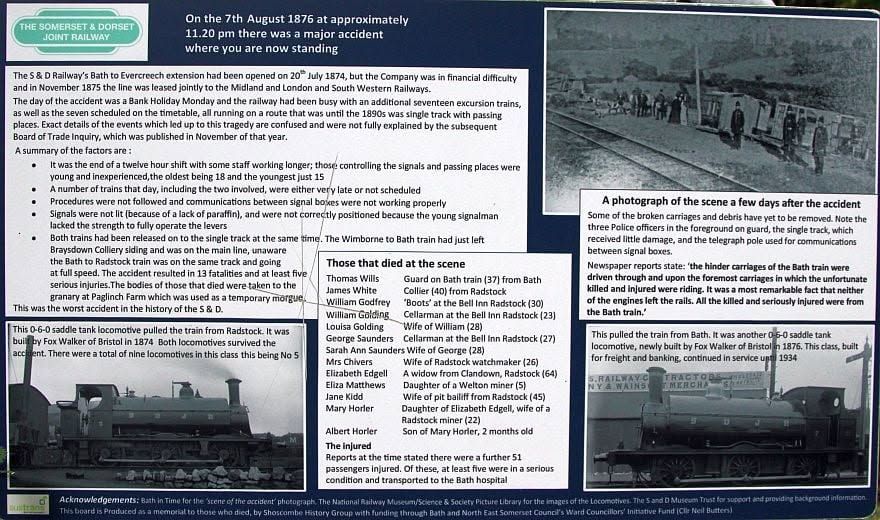
150 years ago today.


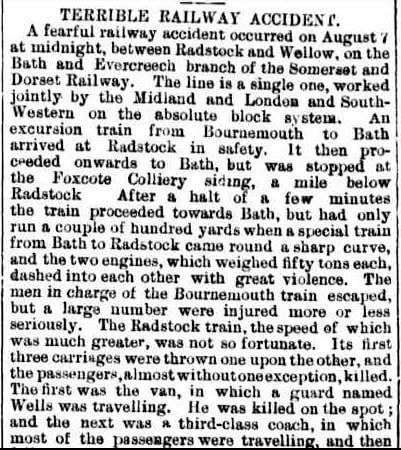
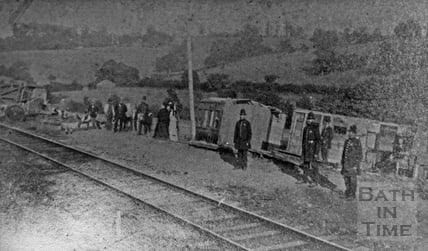
The Radstock Rail Crash at Foxcote on the Somerset & Dorset Line

History - On 7 August 1876 , the August Bank Holiday, the Somerset & Dorset train company ran seventeen extra trains to cater for people enjoying the day off work.

These trains did not appear in the normal timetables and the superintendent at Glastonbury, Caleb Percy, had to arrange crossings i.e. issue instructions as to which trains were to be delayed to allow the special trains to be passed over the single line sections.

He was hampered in this task by poor telegraph communications all day.

Both trains involved in the accident were unscheduled.

The "down" (south-bound) train was supposedly an empty stock train returning from Bath, but large numbers of passengers were aboard, returning to Radstock and nearby villages from a regatta in Bath.

The "up" (north-bound) train was a relief train from Bournemouth, arranged hastily because the scheduled train was overcrowded. Percy and his staff could get very little information on the location of either train.

The replies to their enquiries from the telegraph clerk at Wellow (who was only fifteen, and trying to do the work of the stationmaster who had gone for a drink in Midford) were vague. Those from the clerk at Radstock were apparently deliberately obtuse.

The Radstock telegraph clerk sent on the "up" relief train without receiving any crossing order or ascertaining the location of the "down" train.

Shortly before midnight, the driver of the "up" train pulled up at the Foxcote signal box.

The signalman there, Alfred Dando was barely literate and not physically strong enough to work his signal levers, so the signal arm was somewhere between "safe" and "caution".

The signal lamp was out (as he was not given enough oil to light it), so Dando was waving a hand lantern.

After a few minutes, Dando allowed the train to proceed.

The clerk at Wellow had already sent the "down" stock train on, but without using his block instruments to alert Dando.

The "down" train driver could not see the Foxcote distant signal, as it too was unlit.

He saw the home signal against him, and also saw the other train, too late to avoid a collision.

The accident occurred at 11.20 pm.

The first three carriages were thrown into each other where most of the passengers died.

The wounded were attended too and removed to Bath hospital and the nearby houses.

Colliery workers were assigned the task of removing the bodies, which took a further 12 hours after the accident.

Large bonfires were lit at the edges of the gardens to burn off the many fragments of broken carriages


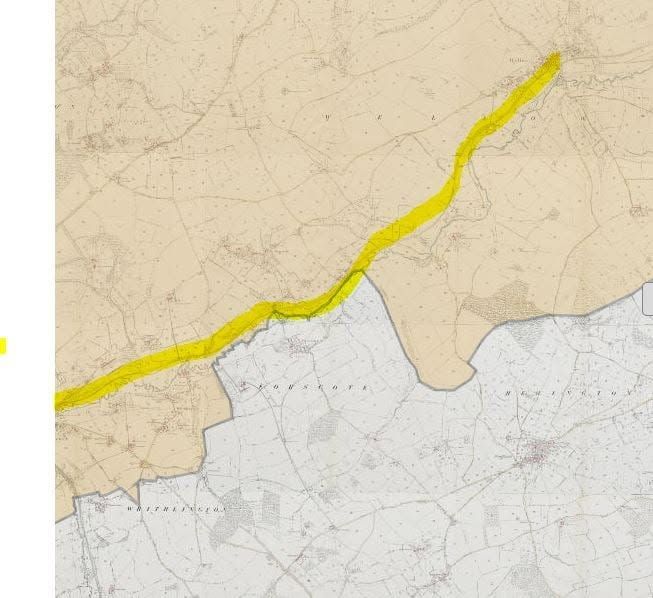
Hauntings? - This stretch of old line is now a cycle track, people have reported an eerie feeling on this section and don't like it at night, there is also maybe a report of someone seeing the ghost of a little girl, a young girl was lost in the accident...


Source- Story - Wikipedia

Old Photo - Ken Marchant - Bath in Time


By Bath Paranormal September 23, 2026
Born on 16 December 1775, Jane Austen remains one of England’s most beloved authors — yet her relationship with Bath was complicated. She lived in the city for several years, drew inspiration from it, disliked it intensely, and ultimately left with a sense of relief. But with such a strong connection to the place, some wonder whether her spirit ever returned. Jane Austen’s Bath Years (1801–1806) When Jane Austen moved to Bath in 1801, the city was a fashionable spa resort, bustling with visitors seeking health, society, and entertainment. Although she never warmed to the city, Bath became the backdrop for two of her six published novels: Northanger Abbey and Persuasion. During her association with Bath — roughly six years — she lived in four different houses, each marking a chapter of her family’s shifting circumstances. 1799 – 13 Queen Square Jane stayed here for a month with her mother during a summer visit. 1801–1804 – 4 Sydney Place After her father, Rev. George Austen, retired from his parish at Steventon, the family settled at 4 Sydney Place. A bronze plaque now marks it as Jane’s principal Bath residence. 1804–1805 – 27 Green Park Buildings The Austen’s moved here on a short lease. It was in this house that Jane’s father died in January 1805. 1805–1806 – 25 Gay Street Jane, her mother, and her sister Cassandra relocated to Gay Street, close to what is now the Jane Austen Centre. They remained only a little over a year before leaving Bath permanently. By the summer of 1806, the family departed for Clifton, then Southampton, and finally Chawton, Hampshire, where Jane spent eight productive years before her death in 1817. She is buried in Winchester Cathedral. Her Feelings About Bath Despite Bath’s influence on her writing, Jane Austen never hid her dislike of living there. After leaving, she wrote to her sister Cassandra: “It will be two years tomorrow since we left Bath for Clifton, with what happy feelings of escape.” Her novels echo this sentiment. In Northanger Abbey, Isabella Thorpe famously complains: “I get so immoderately sick of Bath… we would not live here for millions.” Yet Austen’s detailed observations of Bath society — its balls, promenades, gossip, and social rituals — are woven seamlessly into her fiction. Even if she disliked the city, she understood it intimately. Did Jane Austen’s Ghost Ever Return? With four Bath addresses tied to her life, and two novels rooted in its streets, it’s natural to wonder whether Jane Austen’s spirit lingers in the city she escaped from. There are no confirmed sightings of her ghost in Bath — no documented hauntings at Queen Square, Sydney Place, Green Park Buildings, or Gay Street. But the idea persists in local imagination. She may not have loved Bath, but her connection to it was undeniably strong. The Jane Austen Festival — Bath Today Bath’s relationship with Jane Austen has transformed dramatically since her lifetime. Every September, the city hosts the Jane Austen Festival, one of the largest Regency celebrations in the world. Thousands of visitors arrive in period dress, filling the streets with promenades, dances, readings, and theatrical events. It’s a striking contrast: a city she once longed to escape now celebrates her with devotion. If her spirit ever did wander back, she would find Bath transformed — not the fashionable spa she disliked, but a place where her legacy is cherished. Perhaps that’s why the question remains open: Did Jane Austen ever return to Bath in spirit? Maybe… maybe not — but Bath shaped her life so deeply that the question remains an intriguing one. It would certainly be interesting to know whether any of her former homes have ever reported unusual activity. After all, dislike or not, Bath shaped her life — and her literature — in ways that lasted long after she left.  Created by P Wallace/Bath Paranormal, with AI assistance for writing clarity. **All research, structure, and content choices are my own. This piece draws on publicly available details and historical references.**
By Somerset Paranormal September 23, 2026
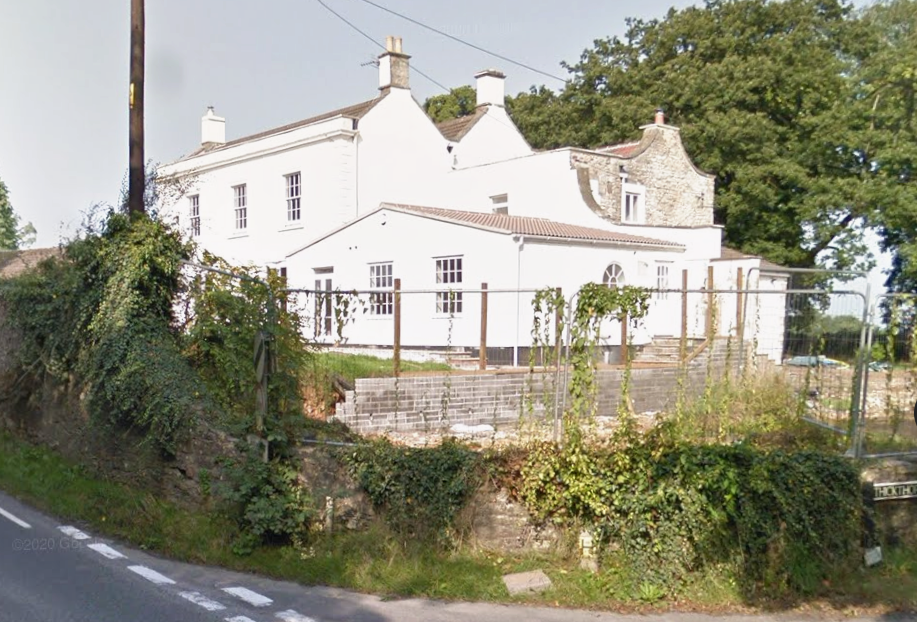
On the rise of Lynch Hill, between Emborough and Chilcompton, stands a house with a quiet presence and a surprisingly tangled identity. Today it is private accommodation, closed to the public and folded back into the landscape. But for decades it was known as The Court Hotel , a place whispered about for its resident ghost — a tall figure in old‑style judicial robes, said to be Judge George Jeffreys, the infamous “Hanging Judge” of the Bloody Assizes. It’s a story that has circulated for years. But when you trace the building’s history, the legend begins to unravel. Linch House: The Building Before the Myth Early maps from the 1800s list the property not as a court, nor as a hotel, but as Linch House . The name comes from the Old English hlinc, meaning a ridge or boundary terrace — a clue that the house stands on land shaped by centuries of agricultural use and early settlement. Somerset is full of “lynch” place‑names marking old field systems and medieval terraces, and Linch House fits neatly into that pattern. This tells us something important: the building began life as a private residence , not a judicial building. Its position on the ridge, overlooking the surrounding lanes, would have made it a desirable spot for a small manor or gentleman’s house. Nothing in its early naming or placement suggests any connection to legal proceedings, assize courts, or the machinery of 17th‑century justice. The 20th‑Century Reinvention: From Linch House to The Court By the time of the 1947 map, the house had adopted a new name: The Court. This kind of renaming was common in the late Victorian and early‑20th‑century period, when rural manor houses often took on grander titles to reflect status, aspiration, or simply fashion. “Court” was a popular choice — it sounded distinguished, landed, and steeped in heritage, even if the building had never hosted a single legal proceeding. This change is the hinge on which the later folklore swings. Once the house became The Court, it became easy — almost inevitable — for people to assume it had once been a court house. And once that assumption took hold, the next step was equally predictable: attaching the name of the West Country’s most notorious judge, George Jeffreys. Judge Jeffreys: A Legend Looking for a Home Jeffreys’ reputation during the Bloody Assizes of 1685 was so severe that his name has become a kind of folkloric shorthand for cruelty. Inns, manor houses, and old buildings across Somerset and Dorset have stories linking him to their walls, often without any historical evidence. In the case of Linch House — later The Court — there is no record of Jeffreys ever visiting the property. His documented circuit passed through Wells, Taunton, Exeter, Dorchester and Salisbury. Emborough and Chilcompton do not appear in any official accounts of the Assizes. The Jeffreys connection here is almost certainly a 20th‑century invention , born from the building’s new name rather than its past. But the haunting itself? That’s a different matter. The Haunting: A Figure on a Familiar Path Witnesses from the hotel era — both staff and guests — describe a tall figure dressed in old‑style clothing, interpreted as judicial robes. He appears in the hallway, walks through what was once the original front door (now sealed), crosses the garden with deliberate purpose, pauses beneath a massive oak tree, and fades away. Even when the apparition doesn’t appear, people have reported the sound of the old front door opening and closing — a door that no longer exists. It’s a quiet, looping haunting. No theatrics. No messages. Just a repeated moment, as though someone is still following a familiar route. And once you remove the Jeffreys myth, the figure becomes far more plausible: a former resident of Linch House, replaying a routine from long before the building was ever called The Court. A Residual Haunting, Not a Judicial One Residual hauntings — those that replay a moment like an echo — often reflect: habitual paths daily routines emotionally charged places long‑term residents The apparition’s behaviour fits this pattern perfectly. He walks a known route, pauses at a known spot, and disappears. Nothing about the haunting suggests a judge delivering verdicts or a figure tied to the Assizes. It feels domestic, not judicial. The “judge” interpretation likely came after the building was renamed The Court, colouring how witnesses described what they saw. What Stands There Today The Court Hotel has long since closed. The building is now believed to be private accommodation, likely converted into flats. The old signage is gone, the car park is quiet, and the house has returned to its original role as a private residence — much like it was when it was still Linch House. Whether the haunting continues is unknown. If the figure is a residual imprint, he may still walk his path regardless of who lives there. If he is something more conscious, perhaps the new residents have seen him — and simply chosen not to share it. A Legend Born From a Name In the end, the haunting of The Court is a story shaped as much by the building’s changing identity as by anything supernatural. A private house becomes The Court, a name invites a legend, and a ghost becomes tied to a judge who never set foot there. Strip away the myth, and what remains is still compelling: a quiet house on a ridge, a figure walking a familiar path, and a story that has grown and shifted with the building itself. Sometimes the truth is simpler. Sometimes the folklore is louder. And sometimes a haunting doesn’t need a famous judge — just a house with a long memory. Images - Google Streetview 2016 Maps - Know your Place - 1888 (Linch House) 1947 (The Court) Articles - British Newspaper Archives  Created by Somerset Paranormal, with AI assistance for writing clarity. All research, structure, and content choices are my own. *UPDATE - On looking through the British Newspaper Archives I have found a few interesting things, Lynch House has been bought and sold quite a few times, as I have found a lot articles of it for sale in different years, it hasn't been in the hands of one family at all, it was let out in 1894, residents include FH Knight, who put in the telephones in 1933, also a Milicent Whitehouse died there in August 1893. There also seems to have been a fire which destroyed the original house in March 1872, see article, when it was the residence of Major Boyle, no one was injured. A Mr S Daniels owned it up to 1948, but it gets its first mention of being a guest house in 1946. Its earliest appearance in the newspapers I can see is in 1838, when it was owned by Mr Green. So to sum up, lots and lots of owners, a fire? just one death recorded, a female and no unusual or interesting events recorded.
By Bath Paranormal September 7, 2026
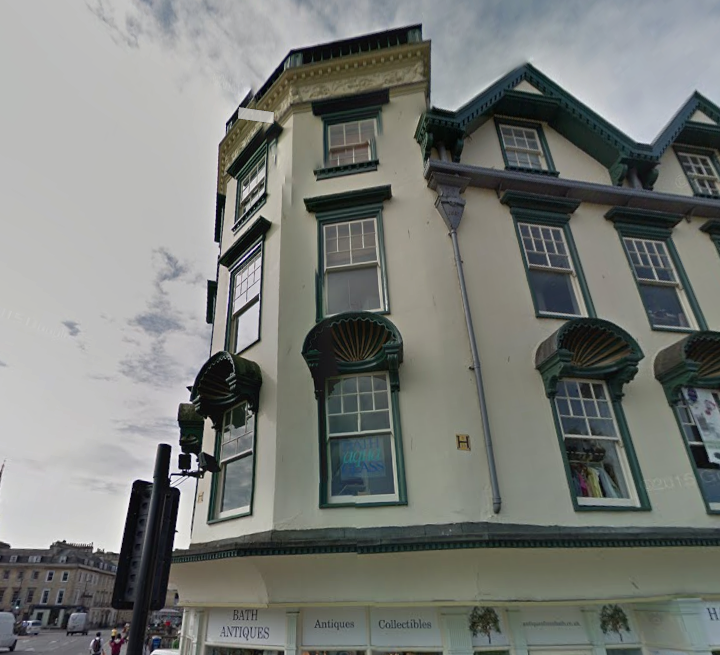
Bath’s Forgotten Corner: The Eerie Legend of No. 1 Orange Grove History - Nos. 1–7 Orange Grove were built between 1705 and 1708 on former Priory churchyard land which was gardens and an orchard beside Bath Abbey, forming one of the city’s earliest commercial terraces. By the 1730s the row already had its distinctive multi‑gabled frontage, facing the fashionable promenade where visitors gathered beneath the 1734 obelisk honouring the Prince of Orange. The shops became part of a lively Georgian hub of busy shops, including a perfumier and Mr Bulls toy shop. In 1897 the architect C.E. Davis refaced the terrace, regularising the gables and rebuilding the corner turret, giving the buildings the striking fairy‑tale silhouette seen today. Behind the neat frontage, the structures remain largely 18th‑century — old cellars, thick walls and uneven floors that have held centuries of Bath’s social life and gossip! The Haunting of No 1 No. 1 Orange Grove is one of the locations frequently highlighted on Bath’s ghost walks, mainly because of its long‑standing reputation for feeling cold, still and unnervingly oppressive, especially on the top floor. Over the years, people have claimed experiences of being pushed or having objects thrown or moved, which is why the tours describe it as a site of poltergeist‑style activity. These reports are impossible to verify and are almost certainly exaggerated for dramatic effect, but the building’s uneasy atmosphere has been talked about locally for a long time. Today No. 1 stands empty, previously an Antiques shop, owned by an elderly landlord, where the rooms lay untouched, adding to the sense of a place suspended in time. Whether the stories grew from genuine experiences or simply from the mood of an old, unused 18th‑century building, No. 1 remains the address most associated with Orange Grove’s darker folklore. Facts and Thoughts - There are mentions of a fire and children perishing, but on researching the address, I have found that there was indeed a small fire, in 1940, but no children perished, just a young maid, who somehow set herself on fire in one of the rooms above at that time a dressmakers and later died in hospital, see the full story below images  No 1 has been a county court office in 1852, a milliners in 1900 and for 30 years or so John Collins was a tobacconist there. I would love to hear from any eye witnesses to paranormal activity in this building, also is there anything reported for the other 6 buildings in the terrace? Real Life at No 1 Sources - Google Streetview 2015 Bath in Time 1945, View over to Orange Grove - 1979, credit - Frank Newport Know Your Place maps
By Somerset Paranormal August 20, 2026
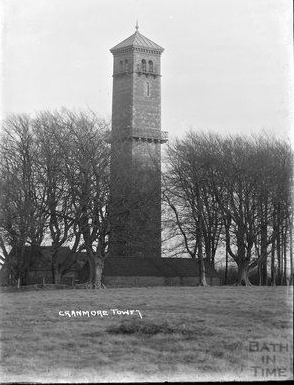
Discover the history and haunting of Cranmore Tower, a Victorian folly on the Mendips with Roman remains, wartime connections and reports of a mysterious ghost.
By P Wallace August 13, 2026
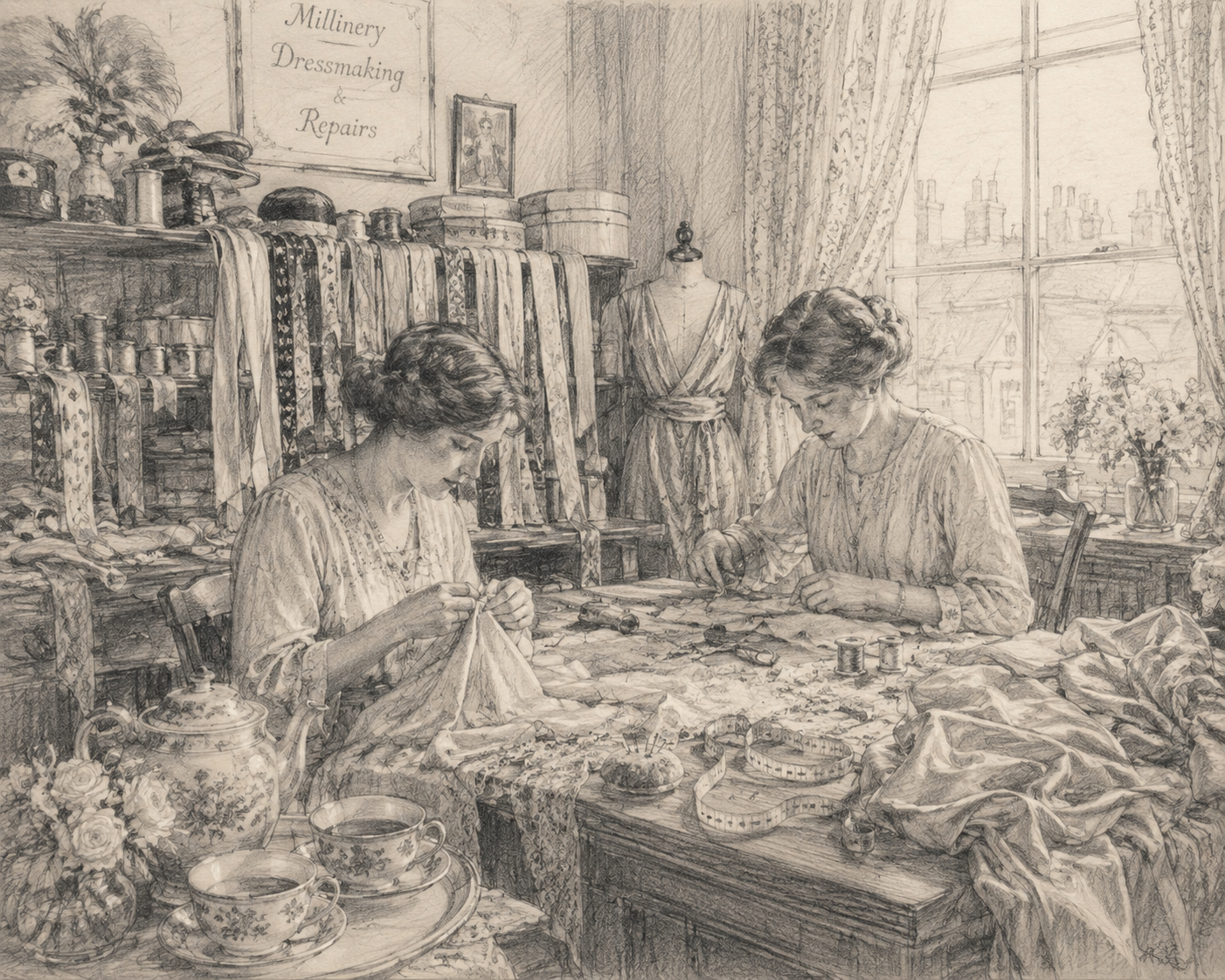
Discover the fascinating story of Bath’s ‘Silk Ladies’ — the women behind a historic dressmaking business, their lives, work and the world of 1920s fashion.
By Somerset Paranormal August 12, 2026
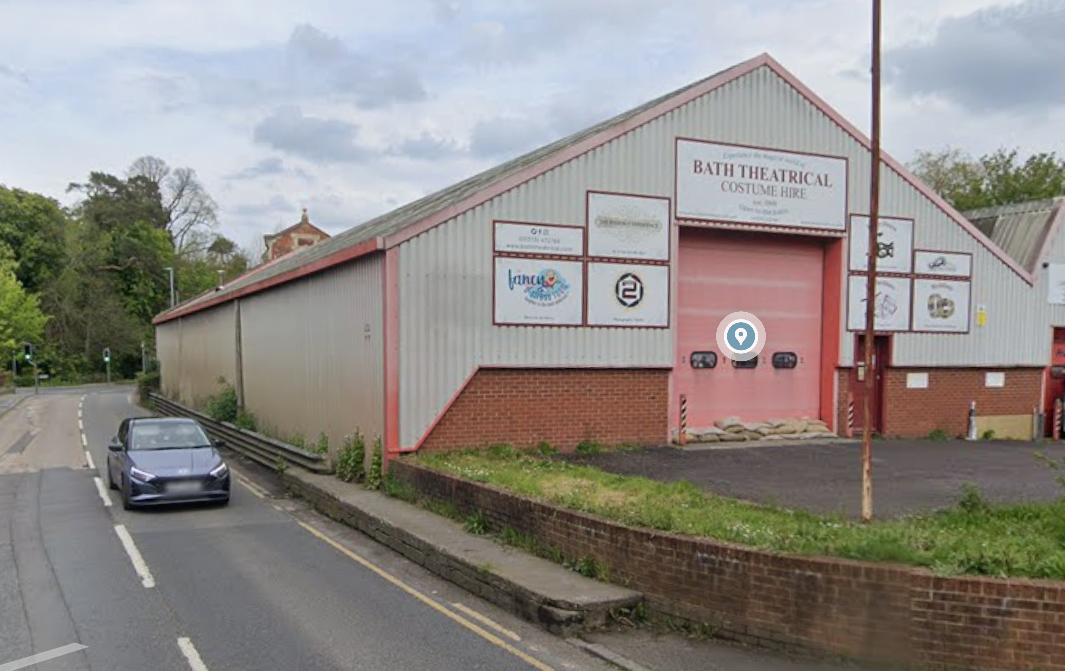
Frome – Bath Theatrical Costume Hire At Unit 8 on Wallbridge Industrial Estate, Bath Theatrical Costume Hire occupies a building with a history of its own. Once a woollen mill, part of the original wall still survives inside the building. The costume hire business moved here in 2001 — and, according to staff, it seems that some of the building’s former inhabitants may have come along too. One of the most frequently encountered spirits is known as James . Staff have occasionally reported the unmistakable smell of cigarette smoke, despite nobody smoking nearby. Keys and pieces of clothing have also been known to disappear, only to mysteriously reappear later in places that are clearly visible. There is a belief that James may have been a Second World War airman , perhaps connected in some way to one of the military uniforms kept within the costume collection. He has also apparently been seen by customers. Staff have reported glimpsing a man standing beside a particular clothing rail, only for him to vanish without a trace when they go over to offer assistance. But James isn't the only presence said to linger here. The building is also possibly a new home to the mysterious “Silk Ladies.” At the original home of the business, in Balustrades, Bath, the owner used to sit on the balcony and sew and would hear the sound of silk skirts swishing up the stairs, giving the name- the Silk Ladies and unmistakable clinking of crockery in the kitchen and gentle ladies chitchat— almost as though an elegant tea party was taking place just out of sight. There have even been reports of the sensation of silk skirts swishing past as the someone glides through the building. So with this in mind, these two spirits are believed to have followed the costume business from its previous premises in Bath. Perhaps the most intriguing question is not who are these spirits? — but why did they choose to follow the business to Frome? Update/ Research - The two women associated with the haunting weren't simply spirits attached to an old building. They were real women who lived and worked at the original premises decades before Bath Theatrical Costume Hire occupied it — and their occupations were remarkably similar to the business that would eventually take over the building, Misses Alice & Marian Patmore were registered at 2 Balustrade, Bath from 1921 - 1935, as milliners & dressmakers.. !  One of the Misses, Marian gave demonstrations to the Women's Institutes in the area in the late 1930's - 1940's, travelling to many villages and spoke about subjects like how to use your coupons efficiently, demonstrations of homemade hats and gave dressmaking hints, she seems to have been a very well known lady. Regarding the building at Balustrade - No. 1 Balustrade (next door) is a former tollhouse, later a shop, and now offices, located at the left end of a terrace. It was built around 1820-1830 and has been altered in the 20th century. The main road at the front of the building was also the Roman Road (Fosse Way) Source - Paranormal Somerset - Selena Wright Britain from Above - Wallbridge Mills 1946 Map 1888 Google Streetview - 2 Ballastrade, Bath 2021 British newspaper Archives & Bath Histrorical Directories
By Somerset Paranormal June 30, 2026
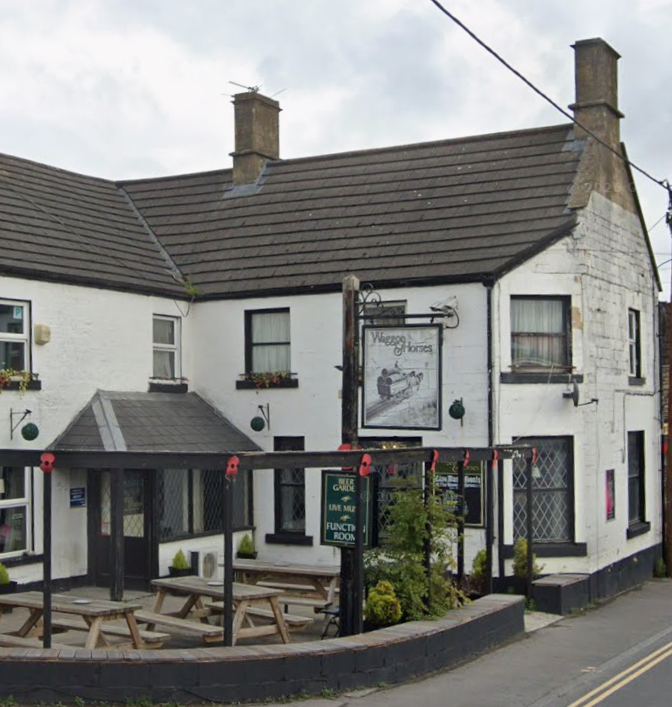
The Waggon & Horses Pub - Peasedown St John History - The pub is said to originally have been a coaching Inn, built in 1810 and located on the now A367 road which cuts through the village, on the exact path of the original Fosseway Roman Road. Hauntings - The spirit of a man possibly known as George, in a black hat is said to be responsible for objects being thrown around, interfering with beer barrels and taps, in the early hours of morning. One beer crate was thrown up the cellar stairs. On a more disturbing note, a woman once awoke in bed to find a ghost of a man standing over her stroking her hair. One article found in the Western Daily Press from September 1976, reports of poltergeist activity at the pub, from a spirit that doesn't like visitors, alters the pressure on the beer kegs and once bombarded the landlord, Mr Norman Harrison with bottles. Thoughts - There is a famous ghost around Peasedown known as the man in the black hat, seen many times on the road of the new bypass and around Wellow Lane, its said that this man is the well known Reverend John Skinner, a 19th-century preacher who travelled between Camerton, Carlingcott, and Peasedown. His story ends tragically—he is said to have taken his own life in Camerton Woods in October 1839. Some believe the figure seen today may be his restless spirit, still walking the roads he once travelled in life. It would be interesting to know if 'George' was a previous landlord or patron? Have anyone ever heard of any other stories for the pub? maybe worked there and had a paranormal experience? Source - Selena Wright - Paranormal Somerset Images - Google Streetview, Know your place maps Rev John Skinner - Radstock Museum/Pinterest
By Somerset Paranormal April 19, 2026
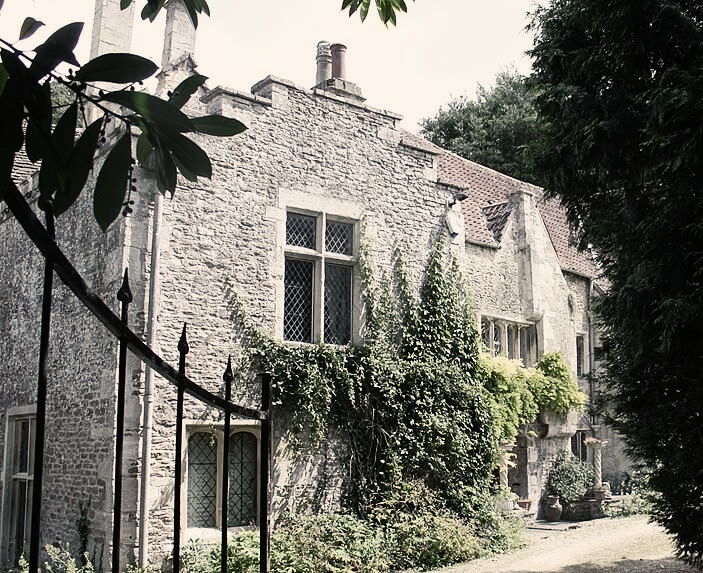
Village Ghost Stories - Beckington, near Frome History - Beckington is a small Somerset village with roots stretching back to the Domesday Book of 1086, where it was recorded as a settled farming community. In medieval times, it grew around the wool trade, with mills along the River Frome supporting local cloth-making. By the 17th century, writers such as John Aubrey noted local traditions, including the claim that carrots were first grown here. The village also saw unrest in 1766, when rioters set fire to a mill during a period of hardship. As the wool industry declined in the 18th and 19th centuries, Beckington became a quieter rural parish. Its church became notable as the burial place of poet Samuel Daniel, while Beckington Castle remained a familiar landmark through changing ownership. In the 20th century, Wool Hall found new life as a recording studio, attracting well-known musicians and adding an unexpected modern note to the village’s history. Hauntings - The Abbey - The building known as The Abbey was begun in 1502 as a college for priests, later becoming a private house after the Dissolution.  Over time it has also been a school, restaurant, and dance hall, before returning to private homes. Although it was never truly an abbey, local tradition says the area is haunted by a grey figure, believed to be an abbess. The Castle - At Castle Corner, The Castle was built in the early 17th century on the site of an earlier building. It has been known as Castle House, and later served as a school, hotel, antiques showroom, and now offices. In 1919, when it was advertised for sale, its reputation for being haunted was included as a selling point. A dark shadow is said to pass through the walls. Do you know of any other ghost stories for Beckington village? Sources - Castle photo - George Love Dafnis/ Bath in Time Know your Place Maps 1888 Drawing & Text © PJW Artworks & Somerset Paranormal
By Somerset Paranormal March 14, 2026
In the village of Hinton St George stands the historic Hinton House, a medieval hall house—sometimes referred to as the Grange—rebuilt around the year 1500. Over the centuries the building has worn many identities. During the Second World War it was used as a school for evacuated girls, and later served as a nursing home before the estate was divided into private apartments in 1968. Yet the house is remembered as much for its ghosts as for its history. The Grey Lady of the Staircase - One of the best-known spirits said to wander the house is a cloaked Grey Lady, believed to have been a member of the historic Poulett family.  According to local tradition, she once fell in love with a man considered beneath her social standing. The two attempted to elope. Her father discovered their plans and intervened violently, reportedly running the young man through with his sword. The tragedy ended the lovers’ hopes forever. The young woman is said to have died soon afterward—some say of grief—and her sorrowful figure is believed to linger still, haunting the old oak staircase where she is occasionally glimpsed moving silently through the shadows. The Spirit of the Young Heir Another presence associated with the house is that of a child: young Frederic Charles Poulett (1798–1808). The boy died after a brief illness at only ten years old. Stories claim that his spirit remains tied to one of the rooms in the house, where unexplained disturbances have long been whispered about. The Ghost of Samuel Day Perhaps the strangest tale connected to the house concerns Samuel Day (1756–1806). Day was injured in a tragic accident when scaffolding collapsed during a parliamentary election in nearby Bridgwater. Though he was taken to a local inn, he died several days later. His body was returned to Hinton House in a lead coffin—so heavy that carrying it up the narrow staircase proved nearly impossible. Instead, the coffin was hoisted by rope through a bedroom window. But disaster struck, the rope snapped. The coffin fell, killing one of the men attempting to guide it inside. After this grim event, reports began to circulate that Samuel Day’s restless spirit appeared near the bedroom window where the accident occurred. According to legend, the haunting grew so troubling that seven priests were summoned to perform an exorcism. They were said to have banished his spirit all the way to the Red Sea—a place from which, the tale insists, no ghost could ever return. © Somerset Paranormal Images - Rare Old Prints online 1829 PJW Artworks
By Bath Paranormal February 24, 2026
Bumps in the Day and a Relentless Female Spirit at Widcombe Crescent.. Bath Widcombe Crescent in Bath is an elegant terrace of fourteen Georgian houses, completed in 1808 to the designs of Thomas Baldwin. Now designated a Grade I listed building, it is particularly noted for its connection to Sir James Brooke — the famed “White Rajah” of Sarawak in Borneo — who made his home at Number 1 between 1831 and 1834. Widcombe Crescent is a quiet road off of Widcombe Hill, but two of its houses have ghostly tales.. the house numbers are with held for privacy.. Ghost Stories- #1 - Bumps in the Day- There was an old lady, who lived with her family, she spent a lot of her time in her bedroom in her twilight years and one day whilst the family were having Sunday lunch she fell out of her chair in the room upstairs, she fell with such a thump that the glass chandeliers rattled.. She sadly declined after the fall and died some months later. The family continued to have their Sunday lunches the same time every week and started to hear a thump noise upstairs which sounded like the sound made previously when the old lady fell out her chair, this started to happen with some regularity, but they could never find anyone there, they kept hearing the thump and just carried on as normal for the following months.. #2 The Terrifying Female Spirit This tale starts with a seemingly normal family, the father was called away to business in London and took the elder son, as soon as he got there he got an urgent message to return home, where he found his wife had committed suicide by poisoning and had also tried to poison the younger son. By some miracle he survived, although scarred physically by his ordeal. The father carried on as a one parent family and was then after some time, suddenly interrupted by the appearance of a female spirit on the stairs.. She had an expression of sheer malice on her face, which terrified the whole household, people would avoid the stairs and run up them when they had to be used for fear of running into her. It proved too much for the family so they moved away. The house then had a multitude of tenants living in it who would always quickly leave and soon it got the reputation as being un lettable. A local parish priest moved in, with a view of ridding the house of this spirit for good, but the female spirit took offence to this and started to appear even more and in all the rooms of the house. The priest decided on an exorcism, which took place with no fewer than 40 priests in attendance, and the female spirit was reported to have been seen by someone in a doorway then.. However this did seem to work, and the female spirit was never seen again.. or has she?? Story Source - Haunted Bath by David Brandon Photo - Widcombe Crescent general view c.1930s - Bath in Time Google Streetview & Know Your Place - Map 1879-1888  #hauntedbath #ghostsofbath #bathghoststories #spiritsofbath #bathparanormal #paranormalbath